
A program record that carries from one season to the next.
A program runs the same year twice over: tryouts, a roster, a summer of getting in front of people, and then it all starts again. Most of what you learn along the way ends up in somebody else's system, or nobody's. ADAPT is one place it lands — round after round of testing, every school that has watched a player, and a way to close August out so September starts clean.
What every player is actually doing, what they have measured, and who has gone quiet.
Which schools watched which players, what camps are worth the drive, and what you can defend when a parent asks.
Every round of testing on one record, so you can show what a player has added rather than what he did once.
Access is invitation-only at the moment.
Development
A roster that tells you who to look at.
Thirty players is too many to hold in your head, and the ones who need you are rarely the ones who ask. The list carries the answer: who has gone quiet, whose arm is flagged, who still has no number and no sizes.
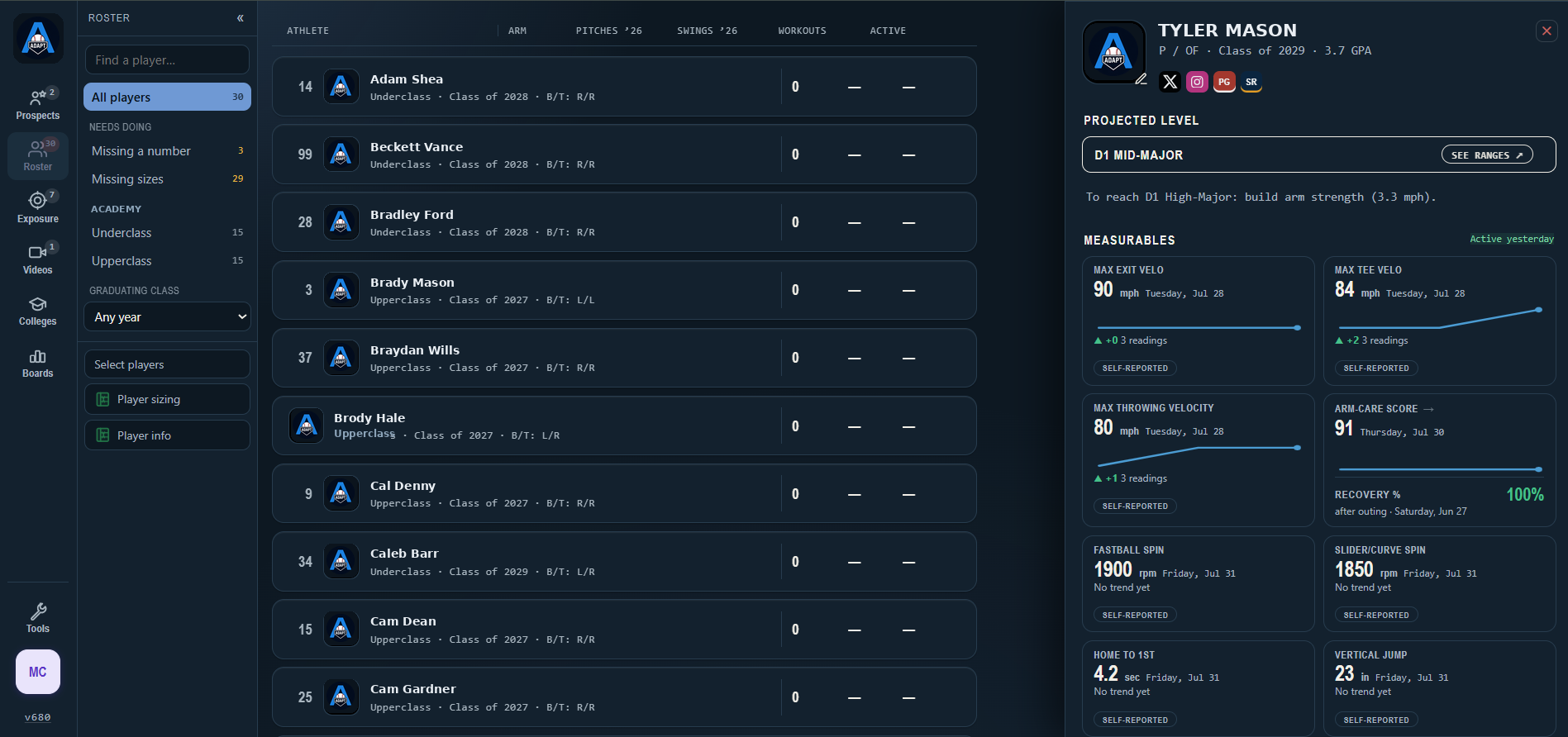
- Tryouts on the 20–80 scaleMeasurables recorded beside every grade, and every evaluation stamped with who wrote it.
- Offers they answer themselvesSend to as many as you pick. They land on your roster when they accept.
- Numbers you did not key inWhat a player logs rolls up to you, and each round of testing joins the same record.
- The dull half tooJersey numbers, uniform sizing with the date taken, and an export a supplier can order from.
Exposure
What you can say when a parent asks.
Every program tells families it gets players seen. Almost none can say by whom, at which event, and on what date. This is the part that makes that answerable — and it is deliberately strict about it: an event only counts once somebody has confirmed who actually turned up.
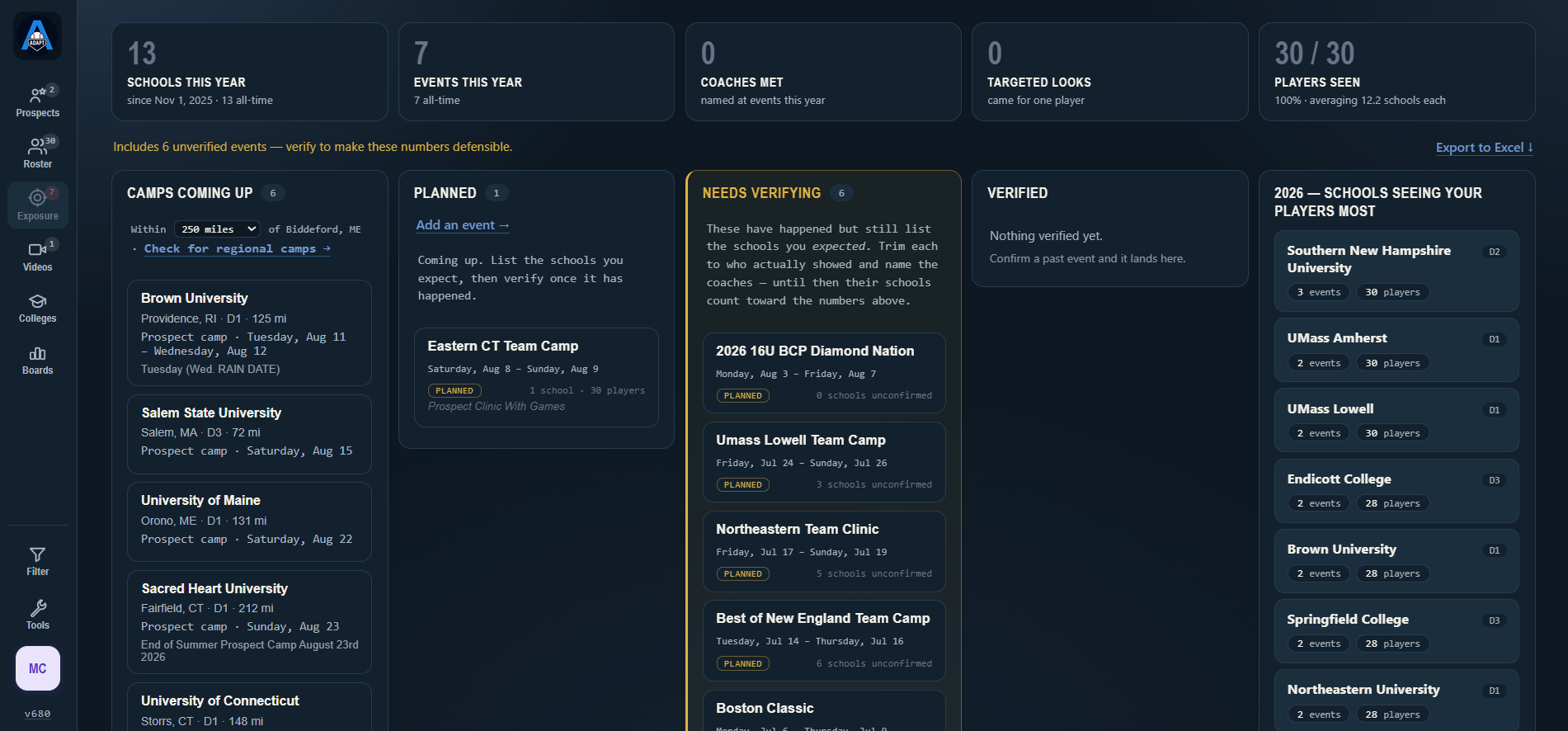
- Camps within rangeThe miles on each one, and anything further away folded underneath rather than dropped.
- Who is watching, this year1 September to 31 August, the way a baseball year actually runs.
- Contact windowsD1, D2 and everyone else follow different rules. The app knows which apply to each player.
Recruiting
A school list where the staff has actually been checked.
A recruiting database is only worth what its worst record is worth. Coaching staff turns over every autumn and nobody notices until an email bounces — so the app reads the school's own coaches page and tells you when a record was last confirmed against it.
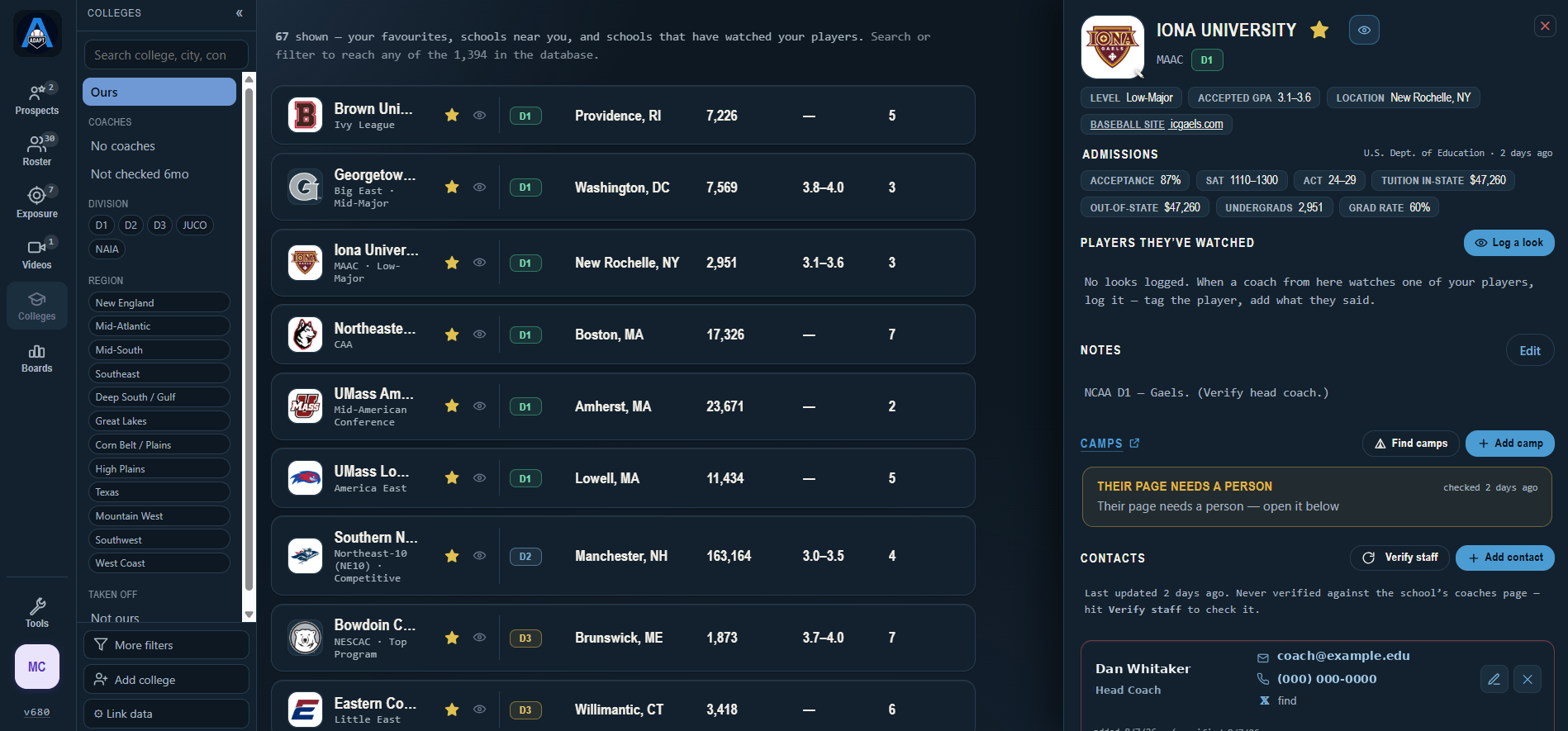
- Verify staffReads the school's own coaches page and tells you what changed.
- Two lists that are jobsSchools with no coaches, and staff not checked in six months. You work through them.
- A wrong record goes for reviewRather than being deleted for everyone by whoever noticed it first.
Growth
The numbers already exist. They are just in six different places.
Most facilities test. The radar gun has its own app, the cage has another, the force plate has a third, and the winter assessment is on a spreadsheet somebody keeps on a laptop. Every one of those systems can tell you what a player did that day. None of them can tell you what he has done since.
ADAPT is the one place it all lands. Run an assessment monthly, quarterly, or twice a year — each round goes onto the same record, so the answer stops being what did he throw in March and becomes what has he added since November. That is the number a program is actually selling.
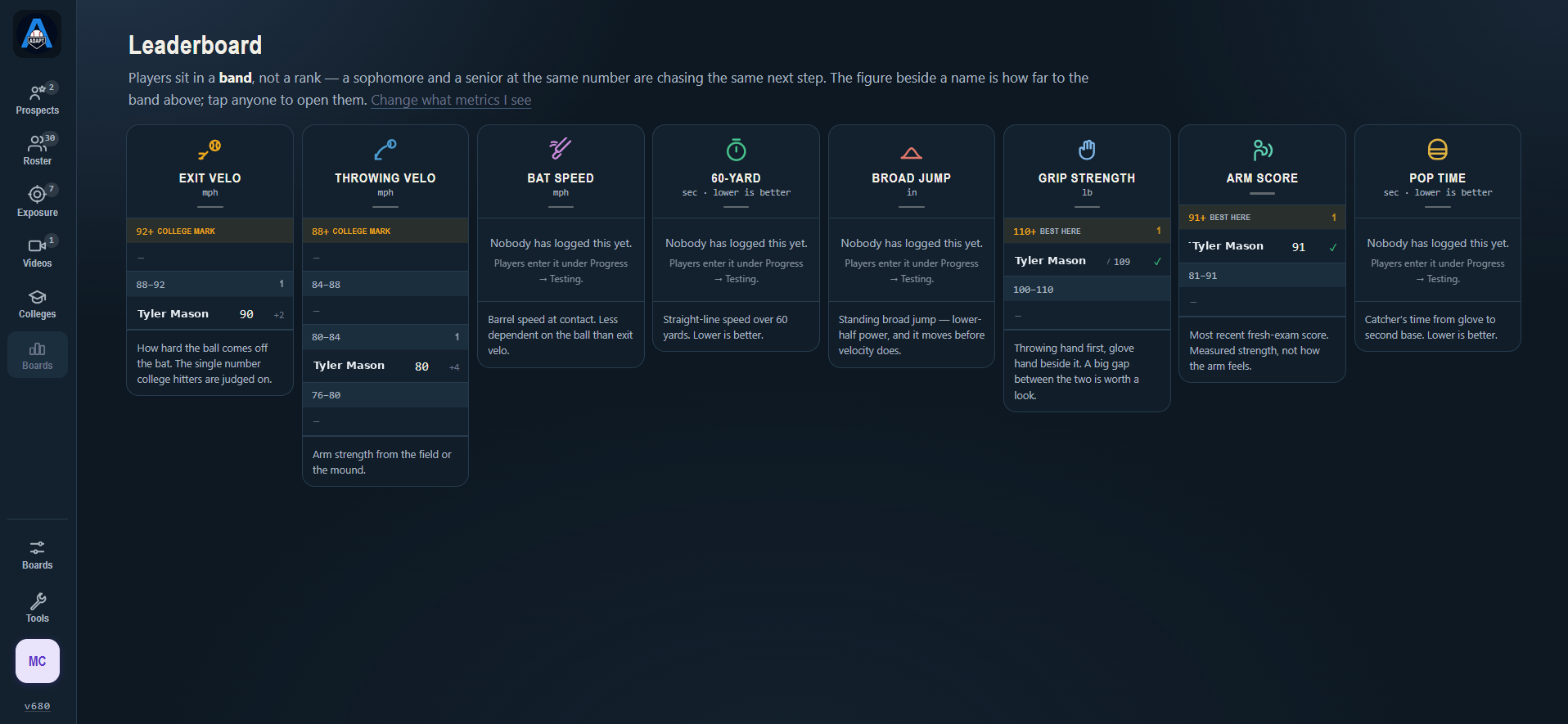
A band, not a rank.
And once you can see movement, ranking a squad becomes the wrong way to show it. Telling a fifteen-year-old he is eleventh is true and useless. A band says something he can act on: here is the range you are in, here is the next one, here is the number that gets you there. A sophomore and a senior throwing 80 are chasing the same next step.
And then it turns over
August is the hard part.
Closing a year is the job every program does badly, because nothing is built for it. ADAPT makes it one screen: a short review for every player, a private note on whether you expect them back, and next year's team set while you are already thinking about them.
Reviews reach the player
Top strengths, what to work on, and closing comments. Nothing is sent until you close the year, so a half-written note stays private.
Next year is already assigned
Mark a player as returning and place him there and then. Closing applies it, and clears everyone else so the roster can be built.
The boards clear
Last season's verified exposure is filed away, still counted for every player and every school, just off the screen you are planning with.
Return rate
The share you expected back, and from the following year, the share who actually were. The gap between the two is the useful part.
Plainly
What you should know before asking.
You don't own the athlete
Players keep their account if they leave. You see training summaries and what your coaches graded — not a family's full record.
Not a data business
We don't sell anything about anyone, there's no advertising, and nobody is profiled for any purpose but running the product.
Every coach gets a login
Evaluations are stamped with who wrote them, so a report is never anonymous. Sharing one account is possible and a bad idea.
Not finished
Built for real programs in real seasons, and it changes most weeks. If something is wrong for you, say so.
Talk to us about your program
Tell us how many players, how many teams, and what August currently looks like.